
Business Strategy
Building a Scalable Business Ecosystem
August 2026Read Article
The operational transformation of AH Transport and AH Logistiek offers a concrete case study in sustainable logistics growth — driven by process improvement, not headcount expansion.
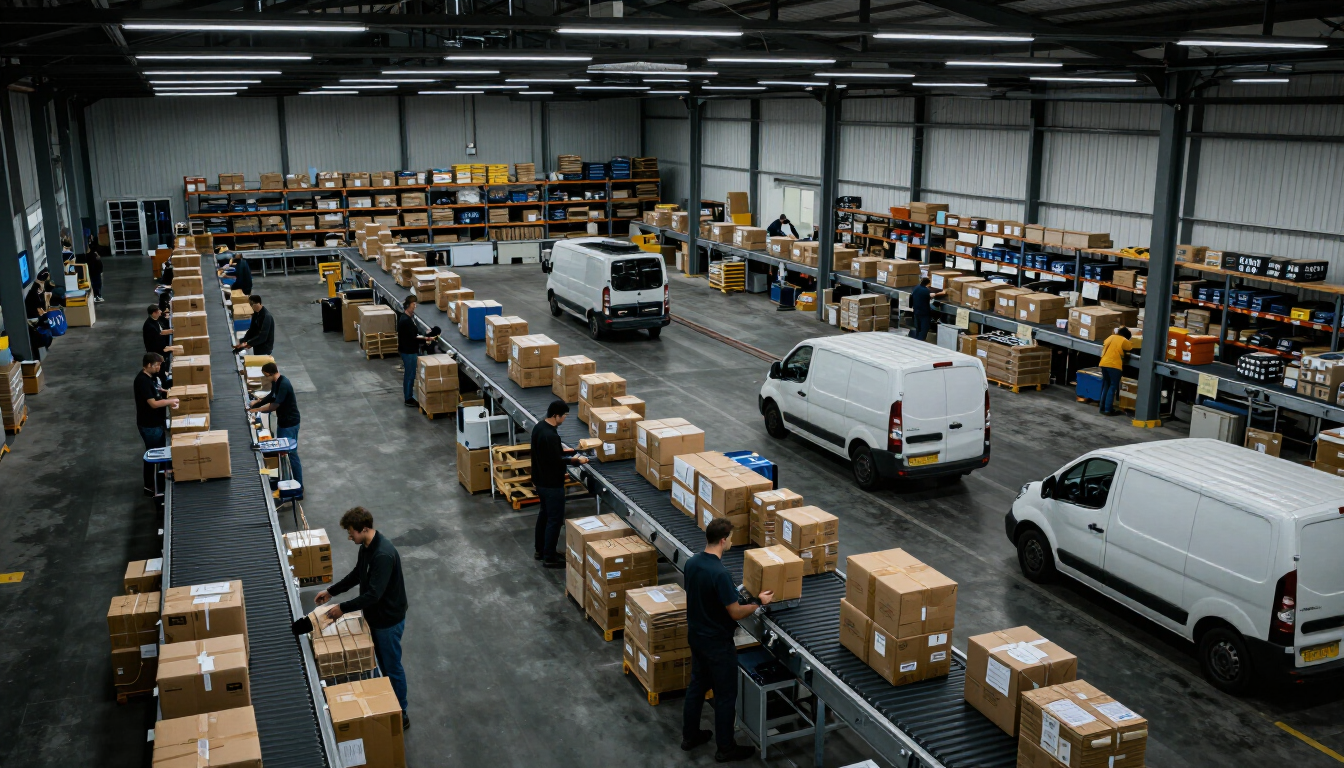
In logistics, volume is a consequence — not a strategy. The most common mistake growing transport companies make is treating headcount and fleet size as the primary levers for growth. The story of AH Transport's parcel volume growth from approximately 3,000 to over 6,500 monthly — reaching nearly 7,800 in July 2026 — is a study in the opposite approach.
When VGS became operationally involved with AH Transport B.V. in 2023, the business had solid foundations: an established client base, reliable operational staff and a track record in the Dutch logistics market. What it lacked were the systematic processes that would allow it to absorb significantly higher volumes without proportionally increasing operational complexity.
The initial assessment identified several interconnected inefficiencies. Route planning was reactive rather than proactive, meaning drivers frequently covered suboptimal distances. Parcel processing at the warehouse level lacked standardised intake and sorting procedures, creating bottlenecks during peak periods. Client communication was inconsistent, which eroded trust and increased inbound query volume — itself a hidden operational cost.
None of these were catastrophic failures. They were exactly the kind of marginal inefficiencies that accumulate imperceptibly in growing businesses, eventually forming a ceiling on sustainable throughput. Addressing them required discipline rather than dramatic intervention.
The restructuring of intake and sorting procedures at the warehouse reduced peak-period bottlenecks within two months of implementation. Standardised route planning templates, updated on a rolling basis using historical volume data, improved driver efficiency across all active routes. A simplified client communication framework reduced inbound query volume and improved customer satisfaction scores.
By early 2026, AH Logistiek B.V. had been established to support the expanding operations. The deliberate decision to structure this as a separate entity — rather than simply expanding AH Transport — was strategic: it created cleaner operational accountability, enabled more precise financial reporting, and positioned both companies for independent growth trajectories within the shared VGS ecosystem.
Reaching approximately 7,800 parcels in July 2026 represented more than a volume milestone. It validated the hypothesis that operational excellence — not aggressive sales — is the most durable growth driver in logistics. The client relationships that generated this volume were built on delivery reliability and transparent communication, not pricing competition.
The lessons from this operational transformation have been systematised into the broader VGS business development framework. When VGS engages with a new logistics partner or supports an entrepreneur building in the transport sector, the same diagnostic and improvement methodology applies. The competitive advantage is not a proprietary algorithm or a technological breakthrough. It is the accumulated operational intelligence of having done the work.
The warehouse renovation — ongoing through Q1–Q3 2026 — will expand physical capacity to support continued volume growth. The international expansion strategy, informed by the operational data accumulated over three years, will apply the same process-first discipline to new markets. Volume is a consequence. Operational excellence is the strategy.

Mohamed Abdulgaadir
Founder & CEO, VGS Group